
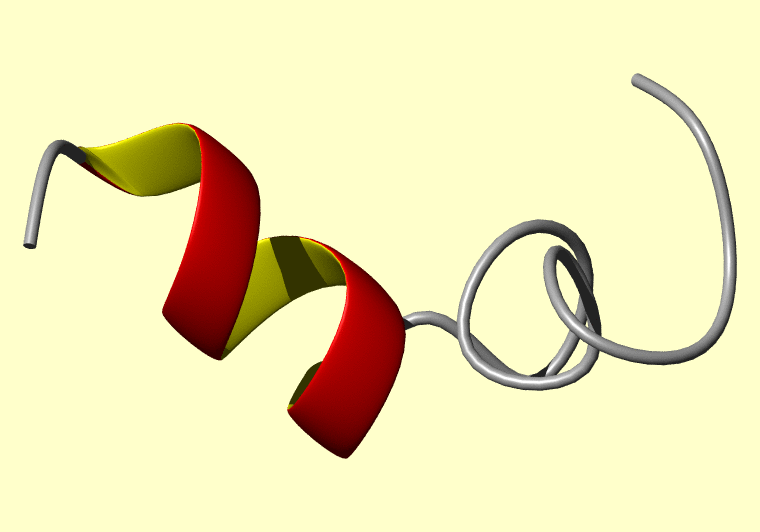
Result table
| image | mrblock_id | pdb_id | bmrb_id | cing | stage | position | program | type |
|
|
538135 | 2lj9 RC | 17926 | cing | 1-original | 5 | XPLOR/CNS | unknown |
{+ file: anneal.inp +}
{+ directory: nmr_calc +}
{+ description: dynamical annealing with NOEs, coupling constants,
                chemical shift restraints starting from extended
                strands or pre-folded structures. +}
{+ authors: Gregory Warren, Michael Nilges, John Kuszewski,
     Marius Clore and Axel Brunger +}
{+ copyright: Yale University +}

{+ reference: Clore GM, Gronenborn AM, Tjandra N, Direct structure refinement
              against residual dipolar couplings in the presence of rhombicity
              of unknown magnitude., J. Magn. Reson., 131, In press, (1998) +}
{+ reference: Clore GM, Gronenborn AM, Bax A, A robust method for determining
              the magnitude of the fully asymmetric alignment tensor of
              oriented macromolecules in the absence of structural
              information., J. Magn. Reson., In press (1998) +}
{+ reference: Garrett DS, Kuszewski J, Hancock TJ, Lodi PJ, Vuister GW,
              Gronenborn AM, Clore GM, The impact of direct refinement against
              three-bond HN-C alpha H coupling constants on protein structure
              determination by NMR., J. Magn. Reson. Ser. B, 104(1),
              99-103, (1994) May +}
{+ reference: Kuszewski J, Qin J, Gronenborn AM, Clore GM, The impact of direct
              refinement against 13C alpha and 13C beta chemical shifts on
              protein structure determination by NMR., J. Magn. Reson. Ser. B,
              106(1), 92-6, (1995) Jan +}
{+ reference: Kuszewski J, Gronenborn AM, Clore GM, The impact of direct
              refinement against proton chemical shifts on protein structure
              determination by NMR., J. Magn. Reson. Ser. B, 107(3), 293-7,
              (1995) Jun +}
{+ reference: Kuszewski J, Gronenborn AM, Clore GM, A potential involving
              multiple proton chemical-shift restraints for
              nonstereospecifically assigned methyl and methylene protons.
              J. Magn. Reson. Ser. B, 112(1), 79-81, (1996) Jul. +}
{+ reference: Nilges M, Gronenborn AM, Brunger AT, Clore GM, Determination
              of three-dimensional structures of proteins by simulated
              annealing with interproton distance restraints: application
              to crambin, potato carboxypeptidase inhibitor and barley
              serine proteinase inhibitor 2. Protein Engineering 2,
              27-38, (1988) +}
{+ reference: Nilges M, Clore GM, Gronenborn AM,  Determination of
              three-dimensional structures of proteins from interproton
              distance data by dynamical simulated annealing from a random
              array of atoms. FEBS LEtt. 239, 129-136. (1988) +}
{+ reference: Rice LM, Brunger AT, Torsion Angle Dynamics: Reduced Variable
              Conformational Sampling Enhances Crystallographic Structure
              Refinement., Proteins, 19, 277-290 (1994) +}
{+ reference: Stein EG, Rice LM, Brunger AT, Torsion angle molecular
              dynamics: a new efficient tool for NMR structure calculation.,
              J. Mag. Res. Ser. B 124, 154-164 (1997) +}
{+ reference: Tjandra N, Garrett DS, Gronenborn AM, Bax A, Clore GM, Defining
              long range order in NMR structure determination from the
              dependence of heteronuclear relaxation times on rotational
              diffusion anisotropy. Nature Struct. Biol., 4(6), 443-9,
              (1997) June +}
{+ reference: Tjandra N, Omichinski JG, Gronenborn AM, Clore GM, Bax A, Use of
              dipolar 1H-15N and 1H-13C couplings in the structure
              determination of magnetically oriented macromolecules in
              solution. Nature Struct. Biol., 4(9), 732-8, (1997) Sept +}

! Data taken from: Qin J, Clore GM, Kennedy WP, Kuszewski J, Gronenborn AM,
!                  The solution structure of human thioredoxin complexed with
!                  its target from Ref-1 reveals peptide chain reversal.,
!                  Structure, 4(5), 613-620, 1996 May 15.

{- Guidelines for using this file:
   - all strings must be quoted by double-quotes
   - logical variables (true/false) are not quoted
   - do not remove any evaluate statements from the file -}

{- begin block parameter definition -} define(

{======================= molecular structure =========================}

{* parameter file(s) *}
{===>} par.1="CNS_TOPPAR:protein-allhdg.param";
{===>} par.2="";
{===>} par.3="";
{===>} par.4="";
{===>} par.5="";

{* structure file(s) *}
{===>} struct.1="generate_seq.mtf";
{===>} struct.2="";
{===>} struct.3="";
{===>} struct.4="";
{===>} struct.5="";

{* input coordinate file(s) *}
{===>} pdb.in.file.1="shortcp12_extended.pdb";
{===>} pdb.in.file.2="";
{===>} pdb.in.file.3="";

{========================== atom selection ===========================}

{* input "backbone" selection criteria for average structure generation *}
{* for protein      (name n or name ca or name c)
   for nucleic acid (name O5' or name C5' or name C4' or name C3'
                     or name O3' or name P) *}
{===>} pdb.atom.select=(name n or name ca or name c);

{====================== refinement parameters ========================}

{* type of molecular dynamics for hot phase *}
{+ choice: "torsion" "cartesian" +}
{===>} md.type.hot="torsion";

{* type of molecular dynamics for cool phase *}
{+ choice: "torsion" "cartesian" +}
{===>} md.type.cool="torsion";

{* refine using different initial velocities or coordinates
   (enter base name in "input coordinate files" field) *}
{+ choice: "veloc" "coord" +}
{===>} md.type.initial="veloc";

{* seed for random number generator *}
{* change to get different initial velocities *}
{===>} md.seed=82364;

{* select whether the number of structures will be either trial or
   accepted structures and whether to print only the trial, accepted,
   both sets of structures. *}
{+ list: The printing format is as follows:
         trial = pdb.out.name + _#.pdb , accepted = pdb.out.name + a_#.pdb +}

{* are the number of structures to be trials or accepted? *}
{+ choice: "trial" "accept" +}
{===>} flg.trial.struc="trial";
{* number of trial or accepted structures *}
{===>} pdb.end.count=150;

{* print accepted structures *}
{+ choice: true false +}
{===>} flg.print.accept=false;
{* print trial structures *}
{+ choice: true false +}
{===>} flg.print.trial=true;

{* calculate an average structure for either the trial or
   accepted structure.  If calculate accepted average is false then
   an average for the trial structures will be calculated. *}

{* calculate an average structure? *}
{+ choice: true false +}
{===>} flg.calc.ave.struct=false;
{* calculate an average structure for the accepted structures? *}
{+ choice: true false +}
{===>} flg.calc.ave.accpt=false;
{* minimize average coordinates? *}
{+ choice: true false +}
{===>} flg.min.ave.coor=false;

{=================== torsion dynamics parameters ====================}

{* maximum unbranched chain length (use <= 0 for automatic) *}
{===>} md.torsion.maxlength=0;

{* maximum number of distinct bodies (use <= 0 for automatic) *}
{===>} md.torsion.maxtree=0;

{========== parameters for high temperature annealing stage ==========}

{* temperature (proteins: 50000, dna/rna: 20000) *}
{===>} md.hot.temp=50000;
{* number of steps (proteins: 1000, dna/rna: 4000) *}
{===>} md.hot.step=1000;
{* scale factor to reduce van der Waals (repel) energy term *}
{===>} md.hot.vdw=0.1;
{* scale factor for NOE energy term *}
{===>} md.hot.noe=150;
{* scale factor for dihedral angle energy term (proteins: 100, dna/rna: 5) *}
{===>} md.hot.cdih=100;
{* molecular dynamics timestep *}
{===>} md.hot.ss=0.015;

{======== parameters for the first slow-cool annealing stage =========}

{* temperature (cartesian: 1000, torsion: [proteins: 50000, dna/rna: 20000]) *}
{===>} md.cool.temp=50000;
{* number of steps *}
{===>} md.cool.step=1000;
{* scale factor for final van der Waals (repel) energy term
   (cartesian: 4.0, torsion: 1.0) *}
{===>} md.cool.vdw=1.0;
{* scale factor for NOE energy term *}
{===>} md.cool.noe=150;
{* scale factor for dihedral angle energy term *}
{===>} md.cool.cdih=200;
{* molecular dynamics timestep (cartesian: 0.005, torsion: 0.015) *}
{===>} md.cool.ss=0.015;
{* slow-cool annealing temperature step (cartesian: 25, torsion: 250) *}
{===>} md.cool.tmpstp=250;

{========= parameters for a second slow-cool annealing stage ==========}

{* cartesian slow-cooling annealing stage to be used only with torsion
   slow-cool annealing stage *}
{* this stage is only necessary when the macromolecule is a protein
   greater than 160 residues or in some cases for nucleic acids *}

{* use cartesian cooling stage? *}
{+ choice: true false +}
{===>} md.cart.flag=true;
{* temperature *}
{===>} md.cart.temp=2000;
{* number of steps *}
{===>} md.cart.step=3000;
{* scale factor for initial van der Waals (repel) energy term *}
{===>} md.cart.vdw.init=1.0;
{* scale factor for final van der Waals (repel) energy term *}
{===>} md.cart.vdw.finl=4.0;
{* scale factor for NOE energy term *}
{===>} md.cart.noe=150;
{* scale factor for dihedral angle energy term *}
{===>} md.cart.cdih=200;
{* molecular dynamics timestep *}
{===>} md.cart.ss=0.005;
{* slow-cool annealing temperature step *}
{===>} md.cart.tmpstp=25;

{=============== parameters for final minimization stage ==============}

{* scale factor for NOE energy term *}
{===>} md.pow.noe=75;
{* scale factor for dihedral angle energy term *}
{===>} md.pow.cdih=400;
{* number of minimization steps *}
{===>} md.pow.step=200;
{* number of cycles of minimization *}
{===>} md.pow.cycl=10;

{============================= noe data ===============================}

{- Important - if you do not have a particular data set then
   set the file name to null ("") -}

{* NOE distance restraints files. *}

{* restraint set 1 file *}
{===>} nmr.noe.file.1="cp12_noe_all20100820_5758.tbl";
{* restraint set 2 file *}
{===>} nmr.noe.file.2="cp12_noe_all20100820_6978.tbl";
{* restraint set 3 file *}
{===>} nmr.noe.file.3="cp12_noe_all20100820_6068.tbl";
{* restraint set 4 file *}
{===>} nmr.noe.file.4="hbond.tbl";
{* restraint set 5 file *}
{===>} nmr.noe.file.5="";

{* NOE averaging modes *}

{* restraint set 1 *}
{+ choice: "sum" "cent" "R-6" "R-3" "symm" +}
{===>} nmr.noe.ave.mode.1="sum";
{* restraint set 2 *}
{+ choice: "sum" "cent" "R-6" "R-3" "symm" +}
{===>} nmr.noe.ave.mode.2="sum";
{* restraint set 3 *}
{+ choice: "sum" "cent" "R-6" "R-3" "symm" +}
{===>} nmr.noe.ave.mode.3="sum";
{* restraint set 4 *}
{+ choice: "sum" "cent" "R-6" "R-3" "symm" +}
{===>} nmr.noe.ave.mode.4="sum";
{* restraint set 5 *}
{+ choice: "sum" "cent" "R-6" "R-3" "symm" +}
{===>} nmr.noe.ave.mode.5="sum";

{======================== hydrogen bond data ==========================}

{* hydrogen-bond distance restraints file. *}
{===>} nmr.noe.hbnd.file="";

{* enter hydrogen-bond distance averaging mode *}
{+ choice: "sum" "cent" "R-6" "R-3" "symm" +}
{===>} nmr.noe.ave.mode.hbnd="sum";

{======================= 3-bond J-coupling data =======================}
{* the default setup is for the phi dihedral *}

{* Class 1 *}

{* 3-bond J-coupling non-glycine restraints file *}
{===>} nmr.jcoup.file.1="";
{* 3-bond J-coupling non-glycine potential *}
{+ choice: "harmonic" "square" "multiple" +}
{===>} nmr.jcoup.pot.1="harmonic";
{* 3-bond J-coupling non-glycine force value *}
{===>} nmr.jcoup.force.1.1=1;
{* 3-bond j-coupling multiple class force second value *}
{===>} nmr.jcoup.force.2.1=0;
{* 3-bond j-coupling Karplus coefficients *}
{* the default values are for phi *}
{===>} nmr.jcoup.coef.1.1=6.98;
{===>} nmr.jcoup.coef.2.1=-1.38;
{===>} nmr.jcoup.coef.3.1=1.72;
{===>} nmr.jcoup.coef.4.1=-60.0;

{* Class 2 *}

{* 3-bond j-coupling glycine restraints files *}
{===>} nmr.jcoup.file.2="";
{* 3-bond J-coupling glycine potential *}
{* The potential for the glycine class must be multiple *}
{+ choice: "harmonic" "square" "multiple" +}
{===>} nmr.jcoup.pot.2="multiple";
{* 3-bond J-coupling first force value *}
{===>} nmr.jcoup.force.1.2=1;
{* 3-bond j-coupling glycine or multiple force second value *}
{===>} nmr.jcoup.force.2.2=0;
{* 3-bond j-coupling Karplus coefficients *}
{* the default values are for glycine phi *}
{===>} nmr.jcoup.coef.1.2=6.98;
{===>} nmr.jcoup.coef.2.2=-1.38;
{===>} nmr.jcoup.coef.3.2=1.72;
{===>} nmr.jcoup.coef.4.2=0.0;

{================ 1-bond heteronuclear J-coupling data ================}

{* Class 1 *}

{* 1-bond heteronuclear j-coupling file *}
{===>} nmr.oneb.file.1="";
{* 1-bond heteronuclear j-coupling potential *}
{+ choice: "harmonic" "square" +}
{===>} nmr.oneb.pot.1="harmonic";
{* 1-bond heteronuclear j-coupling force value *}
{===>} nmr.oneb.force.1=1.0;

{=============== alpha/beta carbon chemical shift data ================}

{* Class 1 *}

{* carbon, alpha and beta, chemical shift restraints file *}
{===>} nmr.carb.file.1="";
{* carbon, alpha and beta, chemical shift restraint potential *}
{+ choice: "harmonic" "square" +}
{===>} nmr.carb.pot.1="harmonic";
{* carbon, alpha and beta, chemical shift restraint force value *}
{===>} nmr.carb.force.1=0.5;

{===================== proton chemical shift data =====================}

{* Class 1 *}

{* class 1 proton chemical shift restraints file *}
{===>} nmr.prot.file.1="";
{* class 1 proton chemical shift potential *}
{+ choice: "harmonic" "square" "multiple" +}
{===>} nmr.prot.pot.1="harmonic";
{* class 1 proton chemical shift force value *}
{===>} nmr.prot.force.1.1=7.5;
{* 2nd class 1 proton chemical shift force value for multi *}
{===>} nmr.prot.force.2.1=0;
{* class 1 proton chemical shift violation cutoff threshold *}
{===>} nmr.prot.thresh.1=0.3;

{* Class 2 *}

{* class 2 proton chemical shift restraints file *}
{===>} nmr.prot.file.2="";
{* class 2 proton chemical shift potential *}
{+ choice: "harmonic" "square" "multiple" +}
{===>} nmr.prot.pot.2="harmonic";
{* class 2 proton chemical shift force value *}
{===>} nmr.prot.force.1.2=7.5;
{* 2nd class 2 proton chemical shift force value for multi *}
{===>} nmr.prot.force.2.2=0;
{* class 2 proton chemical shift violation cutoff threshold *}
{===>} nmr.prot.thresh.2=0.3;

{* Class 3 *}

{* class 3 proton chemical shift restraints file *}
{===>} nmr.prot.file.3="";
{* class 3 proton chemical shift potential *}
{+ choice: "harmonic" "square" "multiple" +}
{===>} nmr.prot.pot.3="harmonic";
{* class 3 proton chemical shift force value *}
{===>} nmr.prot.force.1.3=7.5;
{* 2nd class 3 proton chemical shift force value for multi *}
{===>} nmr.prot.force.2.3=0;
{* class 3 proton chemical shift violation cutoff threshold *}
{===>} nmr.prot.thresh.3=0.3;

{* Class 4 *}

{* class 4 proton chemical shift restraints file *}
{===>} nmr.prot.file.4="";
{* class 4 proton chemical shift potential *}
{+ choice: "harmonic" "square" "multiple" +}
{===>} nmr.prot.pot.4="multiple";
{* class 4 proton chemical shift force value *}
{===>} nmr.prot.force.1.4=7.5;
{* 2nd class 4 proton chemical shift force value for multi *}
{===>} nmr.prot.force.2.4=0;
{* class 4 proton chemical shift violation cutoff threshold *}
{===>} nmr.prot.thresh.4=0.3;

{================ diffusion anisotropy restraint data =================}

{* fixed or harmonically restrained external axis *}
{+ choice: "fixed" "harm" +}
{===>} nmr.dani.axis="harm";

{* Class 1 *}

{* diffusion anisotropy restraints file *}
{===>} nmr.dani.file.1="";
{* diffusion anisotropy potential *}
{+ choice: "harmonic" "square" +}
{===>} nmr.dani.pot.1="harmonic";
{* diffusion anisotropy initial force value *}
{===>} nmr.dani.force.init.1=0.01;
{* diffusion anisotropy final force value *}
{===>} nmr.dani.force.finl.1=1.0;
{* diffusion anisotropy coefficients *}
{* coef: <Tc> <anis> <rhombicity> <wh> <wn> *}

{* Tc = 1/2(Dx+Dy+Dz) in <ns> *}
{===>} nmr.dani.coef.1.1=13.1;
{* anis = Dz/0.5*(Dx+Dy) *}
{===>} nmr.dani.coef.2.1=2.1;
{* rhombicity = 1.5*(Dy-Dx)/(Dz-0.5*(Dy+Dx)) *}
{===>} nmr.dani.coef.3.1=0.0;
{* wH in <MHz> *}
{===>} nmr.dani.coef.4.1=600.13;
{* wN in <MHz> *}
{===>} nmr.dani.coef.5.1=60.82;

{============= susceptability anisotropy restraint data ===============}

{* fixed or harmonically restrained external axis *}
{+ choice: "fixed" "harm" +}
{===>} nmr.sani.axis="harm";

{* Class 1 *}

{* susceptability anisotropy restraints file *}
{===>} nmr.sani.file.1="";
{* susceptability anisotropy potential *}
{+ choice: "harmonic" "square" +}
{===>} nmr.sani.pot.1="harmonic";
{* susceptability anisotropy initial force value *}
{===>} nmr.sani.force.init.1=0.01;
{* susceptability anisotropy final force value *}
{===>} nmr.sani.force.finl.1=50.0;
{* susceptability anisotropy coefficients *}
{* coef: <DFS> <axial > <rhombicity>;
   a0+a1*(3*cos(theta)^2-1)+a2*(3/2)*sin(theta)^2*cos(2*phi) *}

{* DFS = a0 *}
{===>} nmr.sani.coef.1.1=-0.0601;
{* axial = a0-a1-3/2*a2 *}
{===>} nmr.sani.coef.2.1=-8.02;
{* rhombicity = a2/a1 *}
{===>} nmr.sani.coef.3.1=0.4;

{======================== other restraint data ========================}

{* dihedral angle restraints file *}
{* Note: the restraint file MUST NOT contain restraints
         dihedral or end *}
{===>} nmr.cdih.file="CNS_talos30.tbl";

{* DNA-RNA base planarity restraints file *}
{* Note: include weights as $pscale in the restraint file *}
{===>} nmr.plan.file="";
{* input planarity scale factor - this will be written into $pscale *}
{===>} nmr.plan.scale=150;

{* NCS-restraints file *}
{* example is in inputs/xtal_data/eg1_ncs_restrain.dat *}
{===>} nmr.ncs.file="";

{======================== input/output files ==========================}

{* base name for input coordinate files *}
{===>} pdb.in.name="";

{* base name for output coordinate files *}
{===>} pdb.out.name="shortcp12_noe5778_talos30";

{===========================================================================}
{         things below this line do not normally need to be changed         }
{         except for the torsion angle topology setup if you have           }
{         molecules other than protein or nucleic acid                      }
{===========================================================================}
flg.cv.flag=false;
flg.cv.noe=false;
flg.cv.coup=false;
flg.cv.cdih=false;
flg.dgsa.flag=false;
nmr.cv.numpart=10;

 ) {- end block parameter definition -}

checkversion 1.2

evaluate ($log_level=quiet)

structure
   if  (&struct.1 # "") then
      @@&struct.1
   end if
   if  (&struct.2 # "") then
      @@&struct.2
   end if
   if  (&struct.3 # "") then
      @@&struct.3
   end if
   if  (&struct.4 # "") then
      @@&struct.4
   end if
   if  (&struct.5 # "") then
      @@&struct.5
   end if
end

if ( &BLANK%pdb.in.file.1 = false ) then
   coor @@&pdb.in.file.1
end if
if ( &BLANK%pdb.in.file.2 = false ) then
   coor @@&pdb.in.file.2
end if
if ( &BLANK%pdb.in.file.3 = false ) then
   coor @@&pdb.in.file.3
end if

parameter
   if (&par.1 # "") then
      @@&par.1
   end if
   if (&par.2 # "") then
      @@&par.2
   end if
   if (&par.3 # "") then
      @@&par.3
   end if
   if (&par.4 # "") then
      @@&par.4
   end if
   if (&par.5 # "") then
      @@&par.5
   end if
end

if ( $log_level = verbose ) then
  set message=normal echo=on end
else
  set message=off echo=off end
end if

parameter
   nbonds
      repel=0.80
      rexp=2 irexp=2 rcon=1.
      nbxmod=3
      wmin=0.01
      cutnb=6.0 ctonnb=2.99 ctofnb=3.
      tolerance=1.5
   end
end

{- Read experimental data -}

   @CNS_NMRMODULE:readdata ( nmr=&nmr;
                             flag=&flg;
                             output=$nmr; )

{- Read and store the number of NMR restraints -}

   @CNS_NMRMODULE:restraintnumber ( num=$num; )

{- Set mass values -}

do (fbeta=10) (all)
do (mass=100) (all)

evaluate ($nmr.trial.count = 0)    {- Initialize current structure number   -}
evaluate ($nmr.accept.count = 0)   {- Initialize number accepted            -}
evaluate ($nmr.counter  = 0)
evaluate ($nmr.prev.counter = -1)

@CNS_NMRMODULE:initave  ( ave=$ave;
                          ave2=$ave2;
                          cv=$cv;
                          ener1=$ener1;
                          ener2=$ener2;
                          flag=&flg;
                          nmr.prot=&nmr.prot; )

{- Zero the force constant of disulfide bonds. -}
parameter
   bonds ( name SG ) ( name SG ) 0. TOKEN
end

{- define a distance restraints for each disulfide bond, i.e.,
   treat it as if it were an NOE. -}
for $ss_rm_id_1 in id ( name SG ) loop STRM
  for $ss_rm_id_2 in id ( name SG and
     bondedto ( id $ss_rm_id_1 )  ) loop STR2
    if ($ss_rm_id_1 > $ss_rm_id_2) then
      pick bond ( id $ss_rm_id_1 ) ( id $ss_rm_id_2 ) equil
      evaluate ($ss_bond=$result)
      noe
         assign ( id $ss_rm_id_1 ) ( id $ss_rm_id_2 ) $ss_bond 0.1 0.1
      end
    end if
  end loop STR2
end loop STRM

{- Count the number of residues and determine molecule type -}
identify (store9) (tag)
evaluate ($nmr.rsn.num = $SELECT)
identify (store9) ( tag and ( resn THY or resn CYT or resn GUA or
                              resn ADE or resn URI ))
evaluate ($nmr.nucl.num = $SELECT)

{- Improve geometry for torsion angle molecular dynamics -}
evaluate ($flag_tad=false)
if ( &md.type.hot = "torsion" ) then
   if ($nmr.nucl.num > 0) then
      flag exclude * include bond angl impr dihed vdw end
      minimize powell nstep=2000 drop=10.  nprint=100 end
   else
      flag exclude * include bond angl impr vdw end
      minimize powell nstep=2000 drop=10.  nprint=100 end
   end if
   evaluate ($flag_tad=true)
end if

if ( &md.type.cool="torsion") then
   evaluate ($flag_tad=true)
end if

if (&nmr.dani.axis = "harm") then
   do (harmonic=20.0) (resid 500 and name OO)
   do (harmonic=0.0) (resid 500 and name Z )
   do (harmonic=0.0) (resid 500 and name X )
   do (harmonic=0.0) (resid 500 and name Y )
   do (harmonic=0.0) (not (resid 500))
   restraints harmonic exponent=2 end
elseif (&nmr.sani.axis = "harm") then
   do (harmonic=20.0) (resid 500 and name OO)
   do (harmonic=0.0) (resid 500 and name Z )
   do (harmonic=0.0) (resid 500 and name X )
   do (harmonic=0.0) (resid 500 and name Y )
   do (harmonic=0.0) (not (resid 500))
   restraints harmonic exponent=2 end
end if

do (refx=x) ( all )
do (refy=y) ( all )
do (refz=z) ( all )

set seed=&md.seed end

{- Begin protocol to generate structures -- loop until done -}
while (&pdb.end.count > $nmr.counter) loop main

   {- Set parameter values -}
   parameter
      nbonds
         repel=0.80
         rexp=2 irexp=2 rcon=1.
         nbxmod=3
         wmin=0.01
         cutnb=6.0 ctonnb=2.99 ctofnb=3.
         tolerance=1.5
      end
   end

   evaluate ($nmr.trial.count = $nmr.trial.count + 1)

   if (&md.type.initial = "coord") then
      if ($nmr.trial.count < &pdb.end.count) then
         evaluate ($coor_count = $nmr.trial.count)
         evaluate ($coor_count_init=0.)
      else
         evaluate ($coor_count_init=$coor_count_init+1)
         evaluate ($coor_count = $coor_count_init)
         if ($coor_count_init > &pdb.end.count ) then
            evaluate ($coor_count = 1)
         end if
      end if
      set remarks=reset end
      evaluate ($in_file = &pdb.in.name + "_" + encode($coor_count) + ".pdb")
      coor @@$in_file
   else
      do (x=refx) ( all )
      do (y=refy) ( all )
      do (z=refz) ( all )
   end if

   if (&nmr.dani.axis = "fixed" ) then
      fix
         select=(resname ANI)
      end
   elseif (&nmr.sani.axis = "fixed" ) then
      fix
         select=(resname ANI)
      end
   end if

   do ( vx = maxwell(0.5) ) ( all )
   do ( vy = maxwell(0.5) ) ( all )
   do ( vz = maxwell(0.5) ) ( all )

   flags exclude *
         include bond angle dihe impr vdw
                 noe cdih coup oneb carb ncs dani
                 sani harm end

   {- scaling of nmr restraint data during hot dynamics -}

   @CNS_NMRMODULE:scalehot ( md=&md;
                             nmr=&nmr;
                             input.noe.scale=&md.hot.noe;
                             input.cdih.scale=&md.hot.cdih; )

   {- Zero the force constant of disulfide bonds. -}
   parameter
      bonds ( name SG ) ( name SG ) 0. TOKEN
   end

   if ($flag_tad=true) then

      {- initialize torsion dynamics topology for this iteration -}

      dyna torsion
         topology
            maxlength=&md.torsion.maxlength
            maxtree=&md.torsion.maxtree
            {- All dihedrals w/ (force constant > 23) will be locked -}
            {- This keeps planar groups planar -}
            kdihmax = 23.
            @CNS_TOPPAR:torsionmdmods
         end
      end
   end if

{- High temperature dynamics -}

   if ( &md.type.hot = "torsion" ) then

      igroup
     interaction (chemical h* ) (all) weights * 1 vdw 0. elec 0. end
     interaction (not chemical h* ) (not chemical h*) weights * 1 vdw &md.hot.vdw
     end
      end

      dyna torsion
         cmperiodic=500
         vscaling = false
         tcoupling = true
         timestep = &md.hot.ss
         nstep = &md.hot.step
         nprint = 50
         temperature = &md.hot.temp
      end
   else
      evalutate ($md.hot.nstep1=int(&md.hot.step* 2. / 3. ))
      evalutate ($md.hot.nstep2=int(&md.hot.step* 1. / 3. ))
      noe asymptote * 0.1  end
      parameter  nbonds repel=1.   end end
      igroup
     interaction (chemical h* ) (all) weights * 1 vdw 0. elec 0. end
     interaction (not chemical h* ) (not chemical h*) weights * 1 angl 0.4 impr 0.1
                 vdw &md.hot.vdw end
      end

      dynamics cartesian
         cmperiodic=500
         vscaling = true
         tcoupling=false
         timestep=&md.hot.ss
         nstep=$md.hot.nstep1
         nprint=50
         temperature=&md.hot.temp
      end

      noe asymptote * 1.0  end
      igroup
     interaction (chemical h* ) (all) weights * 1 vdw 0. elec 0. end
     interaction (not chemical h* ) (not chemical h*) weights * 1 vdw &md.hot.vdw end
      end

      dynamics cartesian
         cmperiodic=500
         vscaling = true
         tcoupling=false
         timestep=&md.hot.ss
         nstep=$md.hot.nstep2
         nprint=50
         temperature=&md.hot.temp
      end

   end if

{- The first slow-cooling with torsion angle dynamics -}

   flags include plan end

   {- Increase the disulfide bond force constants to their full strength -}
   parameter
      bonds ( name SG ) ( name SG ) 1000. TOKEN
   end

   evaluate ($final_t = 0)

   evaluate ($ncycle = int((&md.cool.temp-$final_t)/&md.cool.tmpstp))
   evaluate ($nstep = int(&md.cool.step/$ncycle))

   evaluate ($ini_vdw =  &md.hot.vdw)
   evaluate ($fin_vdw =  &md.cool.vdw)
   evaluate ($vdw_step = ($fin_vdw-$ini_vdw)/$ncycle)

   if (&md.type.cool = "cartesian") then

      evaluate ($vdw_step = (&md.cool.vdw/&md.hot.vdw)^(1/$ncycle))
      evaluate ($ini_rad  = 0.9)
      evaluate ($fin_rad  = 0.8)
      evaluate ($rad_step = ($ini_rad-$fin_rad)/$ncycle)
      evaluate ($radius=    $ini_rad)

      do (vx=maxwell(&md.cool.temp)) ( all )
      do (vy=maxwell(&md.cool.temp)) ( all )
      do (vz=maxwell(&md.cool.temp)) ( all )

   end if

   {- set up nmr restraint scaling -}

   evaluate ($kdani.inter.flag=false)
   evaluate ($ksani.inter.flag=false)
   evaluate ($kdani.cart.flag=false)
   evaluate ($ksani.cart.flag=false)
   if (&md.cart.flag=true) then
      evaluate ($kdani.inter.flag=true)
      evaluate ($ksani.inter.flag=true)
      @CNS_NMRMODULE:scalecoolsetup ( kdani=$kdani;
                                      ksani=$ksani;
                                      nmr=&nmr;
                                      input.noe.scale=&md.cool.noe;
                                      input.cdih.scale=&md.cool.cdih;
                                      input.ncycle=$ncycle; )
      evaluate ($kdani.cart.flag=true)
      evaluate ($ksani.cart.flag=true)
   else
      @CNS_NMRMODULE:scalecoolsetup ( kdani=$kdani;
                                      ksani=$ksani;
                                      nmr=&nmr;
                                      input.noe.scale=&md.cool.noe;
                                      input.cdih.scale=&md.cool.cdih;
                                      input.ncycle=$ncycle; )
   end if

   evaluate ($bath  = &md.cool.temp)
   evaluate ($k_vdw = $ini_vdw)

   evaluate ($i_cool = 0)
   while ($i_cool <= $ncycle) loop cool
      evaluate ($i_cool = $i_cool + 1)

      igroup
         interaction (chemical h*) (all) weights * 1 vdw 0. elec 0. end
         interaction (not chemical h*) (not chemical h*) weights * 1 vdw $k_vdw end
      end

      if ( &md.type.cool = "torsion" ) then
    dynamics  torsion
       cmremove=true
       vscaling = true
       tcoup = false
       timestep = &md.cool.ss
       nstep = $nstep
       nprint = $nstep
       temperature = $bath
    end
      else
    dynamics  cartesian
       cmremove=true
      vscaling = true
       tcoup = false
       timestep = &md.cool.ss
       nstep = $nstep
        nprint = $nstep
       temperature = $bath
    end
      end if

      if (&md.type.cool = "cartesian") then
      evaluate ($radius=max($fin_rad,$radius-$rad_step))
     parameter  nbonds repel=$radius   end end
         evaluate ($k_vdw=min($fin_vdw,$k_vdw*$vdw_step))
      else
         evaluate ($k_vdw= $k_vdw + $vdw_step)
      end if
      evaluate ($bath  = $bath  - &md.cool.tmpstp)

      @CNS_NMRMODULE:scalecool ( kdani=$kdani;
                                 ksani=$ksani;
                                 nmr=&nmr; )

   end loop cool

{- A second slow-cooling with cartesian dyanmics -}

   evaluate ($flag_cart=false)
   if (&md.cart.flag=true) then
      if (&md.type.cool = "torsion") then

         evaluate ($flag_cart=true)

         dynamics torsion
         topology
            reset
         end
      end

         evaluate ($cart_nucl_flag=false)
         if ($nmr.nucl.num > 0) then
            evaluate ($cart_nucl_flag=true)
            parameter
               nbonds
                  repel=0
                  nbxmod=5
                  wmin=0.01
                  tolerance=0.5
                  cutnb=11.5 ctonnb=9.5 ctofnb=10.5
                  rdie vswitch switch
               end
            end
            flags include elec end
         end if

      evaluate ($ncycle=int((&md.cart.temp-$final_t)/&md.cart.tmpstp))
      evaluate ($nstep=int(&md.cart.step/$ncycle))

      evaluate ($vdw_step=(&md.cart.vdw.finl/&md.cart.vdw.init)^(1/$ncycle))
      evaluate ($ini_rad=0.9)
      evaluate ($fin_rad=0.8)
      evaluate ($rad_step=($ini_rad-$fin_rad)/$ncycle)
      evaluate ($radius=$ini_rad)

         @CNS_NMRMODULE:scalecoolsetup ( kdani=$kdani;
                                         ksani=$ksani;
                                         nmr=&nmr;
                                         input.noe.scale=&md.cart.noe;
                                         input.cdih.scale=&md.cart.cdih;
                                         input.ncycle=$ncycle; )

      do (vx=maxwell(&md.cart.temp)) ( all )
      do (vy=maxwell(&md.cart.temp)) ( all )
      do (vz=maxwell(&md.cart.temp)) ( all )

      evaluate ($bath=&md.cart.temp)
      evaluate ($k_vdw=&md.cart.vdw.init)

      evaluate ($i_cool = 0)
      while ($i_cool <= $ncycle) loop cart
         evaluate ($i_cool = $i_cool + 1)

         igroup
            interaction (chemical h*) (all) weights * 1 vdw 0. elec 0. end
            interaction (not chemical h*) (not chemical h*) weights * 1 vdw $k_vdw
            end
         end

         dynamics  cartesian
            vscaling = true
            tcoup = false
            timestep = &md.cart.ss
            nstep = $nstep
            nprint = $nstep
            temperature = $bath
         end

            if ($cart_nucl_flag=false) then
            evaluate ($radius=max($fin_rad,$radius-$rad_step))
            parameter  nbonds repel=$radius   end end
         end if
         evaluate ($k_vdw=min(&md.cart.vdw.finl,$k_vdw*$vdw_step))
         evaluate ($bath=$bath-&md.cart.tmpstp)

            @CNS_NMRMODULE:scalecool ( kdani=$kdani;
                                       ksani=$ksani;
                                       nmr=&nmr; )

      end loop cart

      end if
   end if

   {- reset torsion angle topology -}
   if ( $flag_tad=true ) then
      if ($flag_cart=false) then
         dynamics torsion
            topology
               reset
            end
         end
      end if
   end if


{- Final minimization -}

   {- turn on proton chemical shifts -}

   flags include prot end

   noe
      scale * &md.pow.noe
   end

   restraints dihedral
      scale = &md.pow.cdih
   end

   igroup interaction ( all ) ( all ) weights * 1 end end

   evaluate ($count=0 )
   evaluate ($nmr.min.num=0.)
   while (&md.pow.cycl > $count) loop pmini

      evaluate ($count=$count + 1)
      minimize powell nstep=&md.pow.step drop=10.0 nprint=25 end
      evaluate ($nmr.min.num=$nmr.min.num + $mini_cycles)

   end loop pmini

   {- translate the geometric center of the structure to the origin -}
   if ($num.dani > 0. ) then
   elseif ($num.sani > 0. ) then
   else
      show ave ( x ) ( all )
      evaluate ($geom_x=-$result)
      show ave ( y ) ( all )
      evaluate ($geom_y=-$result)
      show ave ( z ) ( all )
      evaluate ($geom_z=-$result)
      coor translate vector=( $geom_x $geom_y $geom_z ) selection=( all ) end
   end if

   @CNS_NMRMODULE:printaccept ( ave=$ave;
                                ave2=$ave2;
                                cv=$cv;
                                ener1=$ener1;
                                ener2=$ener2;
                                flag=&flg;
                                md=&md;
                                nmr=&nmr;
                                num=$num;
                                output=$nmr;
                                pdb=&pdb;  )

end loop main

   @CNS_NMRMODULE:calcave ( ave=$ave;
                            ave2=$ave2;
                            cv=$cv;
                            ener1=$ener1;
                            ener2=$ener2;
                            flag=&flg;
                            md=&md;
                            nmr=&nmr;
                            num=$num;
                            output=$nmr;
                            pdb=&pdb;  )


stop